Fresh Gir cow milk, 15% off!
The Biological Surplus: Do Cows Really Produce More Milk Than Their Calves Need?
Myth vs Fact
1/7/20264 min read
This is a complex issue that bridges biology, ethics, and ancient tradition. The argument that "milk is only for the calf" is biologically true for wild mammals, but the context changes significantly when looking at domesticated dairy cattle breeds, historical evolution, and traditional practices.
Here is an evidence-based breakdown of the argument from scientific, veterinary, and Ayurvedic perspectives.
1. Biological & Veterinary Perspective: Do Cows Produce "Excess" Milk?
From a purely veterinary standpoint, modern domesticated dairy cows produce milk far in excess of what a calf can consume. This is due to thousands of years of selective breeding and domestication.
Calf Nutritional Requirements:
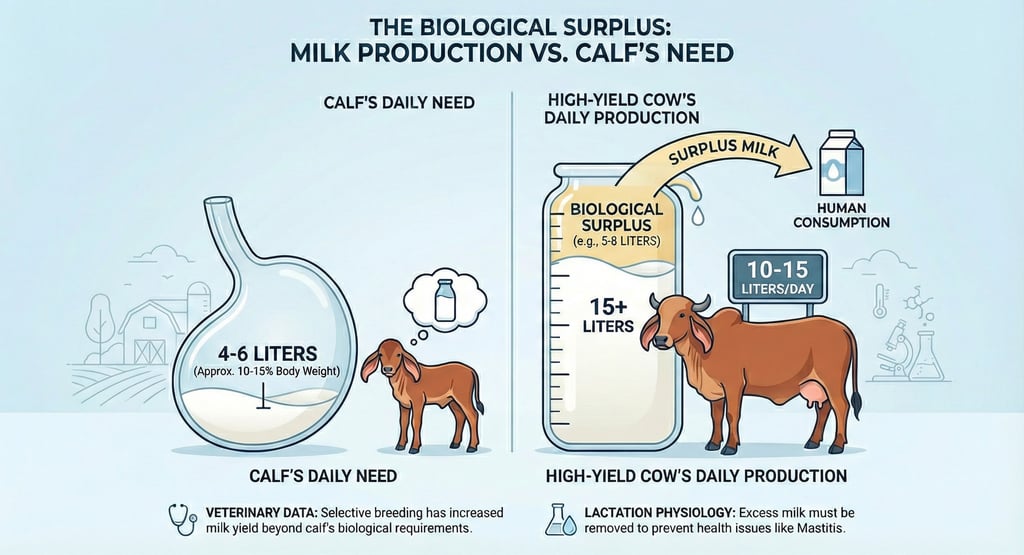
A newborn calf typically requires milk equivalent to 10–15% of its body weight daily.
For an average calf weighing 30–40 kg, this amounts to roughly 4 to 6 liters of milk per day.
Overfeeding a calf (e.g., forcing it to drink 15+ liters) can lead to severe digestive scour (diarrhea) and metabolic issues.
Cow Milk Yield:
High-Yield Breeds (e.g., Holstein): Can produce 25 to 40+ liters per day.
Indigenous Breeds (e.g., Gir, Sahiwal): Typically produce 8 to 15 liters per day.
The Surplus: Even with lower-yield indigenous breeds, if a cow produces 12 liters and the calf drinks 6, there is a biological surplus of 6 liters.
Physiological Necessity of Milking:
Lactation is driven by hormones (Prolactin and Oxytocin). If a high-yielding cow is not milked out completely (after the calf feeds), the pressure in the udder builds up.
This pressure triggers a feedback mechanism involving a protein called FIL (Feedback Inhibitor of Lactation), which signals the body to stop producing milk.
Veterinary Risk: Leaving excess milk in the udder significantly increases the risk of Mastitis (painful infection of the udder). Therefore, in high-yield breeds, milking the surplus is actually necessary for the cow's health.
2. Evolutionary Perspective: Natural Trait vs. Selective Breeding
Critics of dairy consumption argue that this "surplus" is man-made, not natural.
The Role of Selective Breeding:
Wild cattle ancestors (Bos primigenius) likely produced just enough milk for their offspring.
However, humans have practiced artificial selection for over 8,000 years, breeding cows that naturally have larger udders and higher metabolic priorities for lactation.
Today, this trait is genetic. You cannot simply stop milking a modern dairy cow and expect her to "adjust" to the calf's needs immediately without causing her suffering.
The "Symbiosis" Argument:
Evolutionary biologists often view domestication as a symbiotic relationship.
The Exchange: Humans provided protection from predators, guaranteed food, and shelter. In exchange, cows provided surplus milk, manure (fertilizer), and labor.
From this view, the "surplus" milk is the cow's biological contribution to the cooperative relationship with humans.
3. The Ayurvedic Perspective: Ethics & Nutrition
Ayurveda does not view milk consumption as stealing; rather, it views it as a "gift" that is contingent on ethical treatment.
The "Two-Teat" Rule (Ethical Milking):
Traditional Indian husbandry followed a strict rule: "Two teats for the calf, two for the home."
This ensures the calf is fully satiated before the human takes the remainder.
Vedic Warning: Ancient texts strictly forbid consuming milk if the calf is starved or if the cow is stressed. Milk obtained through violence or deprivation is considered Abhakshya (unfit for consumption) and toxic to the mind/body.
Qualities of Milk (Dugdha):
Sattvic: Cow milk is considered Sattvic, meaning it promotes clarity, peace, and spiritual inclination.
Ojas: It is the primary food for building Ojas (the essence of vitality and immunity).
Rasayana: It is classified as a rejuvenator, specifically for the brain (Medhya), bones, and reproductive system.
Conditions for Consumption:
Ayurveda states milk should ideally be consumed warm and spiced (with turmeric/ginger) to aid digestion. Cold, homogenized milk is often considered distinct and harder to digest (Kapha aggravating).
4. Scientific Health Impact: Human Consumption
Research on dairy is extensive, with findings supporting both benefits and drawbacks depending on genetics and milk quality.
Arguments Supporting Dairy Intake:
Nutrient Density: Milk is a "complete" food, providing high bioavailability of Calcium, Vitamin B12, Iodine, Potassium, and complete proteins (Casein and Whey).
Bone Health: Meta-analyses generally support milk's role in bone density and preventing osteoporosis in the elderly.
A2 Milk Research: Emerging studies suggest that A2 milk (from indigenous cows like Gir) is less inflammatory and does not produce BCM-7 (a peptide linked to gut issues), making it a healthier option than standard industrial A1 milk.
Arguments Questioning Dairy Intake:
Lactose Intolerance: Approximately 65% of the global human population has a reduced ability to digest lactose after infancy. For these populations, milk causes inflammation and digestive distress.
Hormonal Concerns: Industrial milk often contains naturally occurring growth factors (IGF-1). High levels of IGF-1 have been epidemiologically linked to acne and, in some studies, certain cancers (prostate), though the data remains debated.
5. Summary: The Ethical Comparison
Here is a balanced comparison of the two dominant ethical viewpoints:
ViewpointThe Vegan / Abolitionist ArgumentThe Traditional / Symbiotic ArgumentCore BeliefAnimals are not resources. Using their secretions is inherently exploitative.Humans and cows have a symbiotic, familial relationship (Gau Mata).The CalfThe milk belongs exclusively to the calf. Any amount taken by humans is theft.The calf has first right. Humans may take the surplus only after the calf is full.Male CalvesIn the dairy industry, male calves are often slaughtered or abandoned. Therefore, dairy supports slaughter.In traditional systems (and ethical Gaushalas), male calves were used for agriculture (bulls). Abandoning them is a violation of Dharma.BiologyCows are artificially bred to overproduce, which is physically taxing and unnatural.Breeding for yield is part of domestication. If the cow is fed well and loved, high production is not "suffering."ConclusionUnethical. Humans should obtain nutrients from plants.Ethical, provided the cow is treated with reverence, the calf is fed, and the milk is A2/organic.
Final Verdict
Evidence suggests that dairy cows do biologically produce a surplus of milk beyond what a calf can safely consume.
If your concern is biological theft: The evidence shows a surplus exists.
If your concern is industrial cruelty: The vegan argument is strong regarding factory farms where calves are separated immediately and cows are treated as machines.
If your concern is spiritual/traditional: Ayurveda and Indian culture support milk consumption only within a framework of non-violence (Ahimsa), where the cow is part of the family and the calf is never deprived.
Recommendation: If you choose to consume milk, the ethical path aligns with Ahimsa: sourcing milk from farms (like authentic Gir Gaushalas) that keep calves with mothers, do not slaughter male calves, and allow the cow to graze freely.