Fresh Gir cow milk, 15% off!
The Golden Elixir: A Detailed Exploration of the Ayurvedic and Scientific Benefits of Gir Cow Ghee
Gir Cow Ghee
1/7/20265 min read
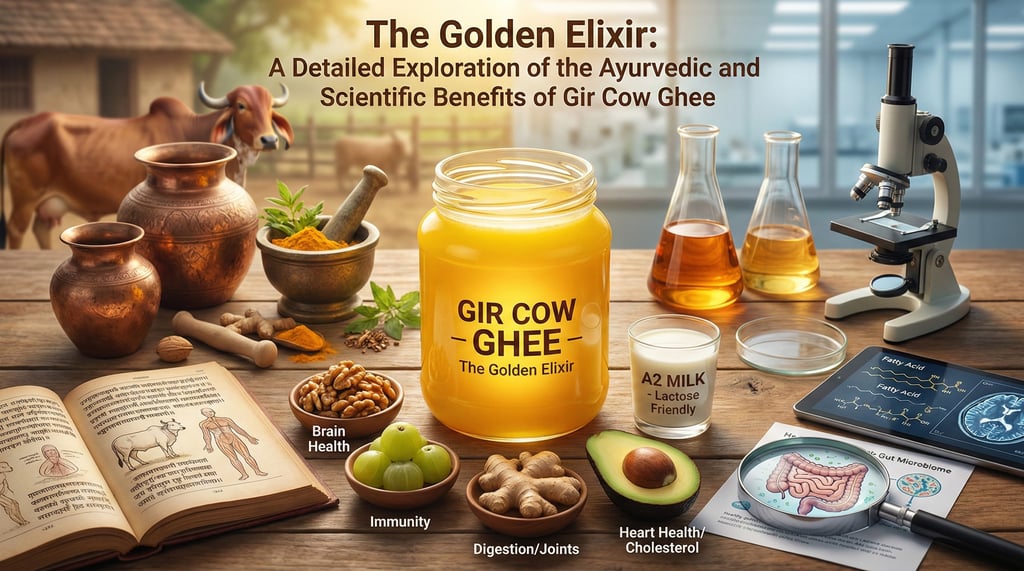
In the pantheon of superfoods, few hold a position as revered as Ghee (clarified butter) in Indian culture. However, not all ghee is created equal. The revival of traditional dairy practices has brought the focus back to Gir Cow Ghee—a premium A2 ghee derived from the indigenous Bos indicus breed of India, prepared using the ancient 'Bilona' (hand-churning) method.
Unlike commercial ghee produced from the A1 milk of hybridized cows using industrial centrifugation, Gir Cow Ghee is considered a medicinal substance. It is the convergence of superior genetics (the resilient Gir breed) and superior processing (the Vedic Bilona method).
This article examines the multifaceted benefits of Gir Cow Ghee, supported by classical Ayurvedic texts and corroborated by modern scientific understanding.
1. Digestive Health and the Power of Butyrate
The cornerstone of good health is digestion. Gir Cow Ghee is uniquely suited to heal and maintain the gastrointestinal tract.
The Scientific Perspective: Gir Cow Ghee is one of the richest natural sources of Butyric Acid (Butyrate), a short-chain fatty acid. Butyrate is the primary energy source for the cells lining the colon (colonocytes). It is crucial for maintaining the integrity of the gut barrier, preventing "leaky gut," and reducing intestinal inflammation.
Research Context: Studies have shown that butyrate exhibits strong anti-inflammatory effects in the gut and is essential for maintaining intestinal homeostasis. It has been studied for its potential in managing conditions like Inflammatory Bowel Disease (IBD) and Crohn's disease.
Reference study on Butyrate’s anti-inflammatory properties in the gut: Frontiers in Immunology
The Ayurvedic Perspective: In Ayurveda, digestion is governed by Agni (digestive fire). Weak Agni leads to the formation of Ama (toxins). Gir Ghee is revered because it stimulates Agni without aggravating Pitta (the fire element), unlike other oils which can be heating and irritating.
The Charaka Samhita, a foundational Ayurvedic text, states:
"Ghee stimulates digestion, warding off diseases caused by aggravated Vata and Pitta... it is the ultimate fuel for the digestive fire."
By lubricating the intestinal tract and stoking the digestive fire, it ensures optimal nutrient absorption.
2. Cognitive Booster and Brain Health (Medhya Rasayana)
The brain is approximately 60% fat, requiring high-quality lipids to function and repair. Gir Cow Ghee provides the essential fats necessary for cognitive longevity.
The Scientific Perspective: Gir Ghee contains beneficial fats, including Omega-3 fatty acids (DHA) and cholesterol, which are vital for maintaining the structure of brain cells and the myelin sheath that insulates nerve fibers. Adequate intake of these healthy fats is linked to improved memory and reduced risk of neurodegenerative diseases.
Research Context: Dietary lipids affect brain structure and function. DHA, found in grass-fed dairy fat, is critical for neuronal survival and signaling.
Reference on dietary lipids and brain function: National Institutes of Health (NIH) database
The Ayurvedic Perspective: Ayurveda classifies Ghee as the supreme Medhya Rasayana—a rejuvenator of the intellect/mind. It nourishes the Majja Dhatu (nervous tissue and bone marrow).
Ayurvedic texts emphasize its ability to improve three aspects of mental faculty:
Dhi (Intelligence/Learning)
Dhriti (Retention/Memory)
Smriti (Recall)
It is traditionally used in preparations given to children to boost academic performance and to the elderly to prevent memory loss.
3. Cardiovascular Health and Cholesterol Balance
For decades, ghee was vilified due to the "fat fear" propaganda. However, modern science distinguishes between healthy saturated fats and harmful trans-fats.
The Scientific Perspective: Gir Cow Ghee, particularly when sourced from grass-fed cows, is rich in Conjugated Linoleic Acid (CLA). CLA is a fatty acid known to have protective properties against heart disease. Furthermore, pure ghee does not contain harmful hydrogenated trans-fats found in margarine or vanaspati.
Research indicates that moderate consumption of traditional ghee can actually improve the lipid profile by increasing HDL (High-Density Lipoprotein - the "good" cholesterol) while not significantly altering LDL in harmful ways.
Research Context: Studies on rural populations consuming traditional ghee have often shown lower incidences of coronary heart disease compared to those consuming modern vegetable oils high in inflammatory Omega-6s. CLA has been studied for its anti-atherogenic (preventing plaque buildup in arteries) properties.
Reference on CLA and cardiovascular health benefits: American Journal of Clinical Nutrition
The Ayurvedic Perspective: Ayurveda views Ghee as a lubricator of the Srotas (body channels). When channels are flexible and clear, circulation is optimal. While excessive consumption of heavy foods is contraindicated, medicinal doses of ghee are considered supportive of the heart (Hridya).
4. Strengthening Immunity and Ojas
In an era focused on immunity, Gir Cow Ghee acts as a fundamental building block for bodily resilience.
The Scientific Perspective: Gir Ghee is a carrier of vital fat-soluble vitamins:
Vitamin A: Crucial for immune function, vision, and skin health.
Vitamin E: A powerful antioxidant that protects cells from damage.
Vitamin K2: Essential for directing calcium to bones and teeth, keeping it out of arteries.
Because these vitamins are fat-soluble, consuming them in the medium of high-quality ghee ensures maximum bioavailability and absorption.
The Ayurvedic Perspective: The ultimate concept of immunity in Ayurveda is Ojas. Ojas is the subtle essence of all bodily tissues (Dhatus) and represents vitality, vigor, and immunity.
The Ashtanga Hridayam states that Ghee is the substance most similar in quality to Ojas. Therefore, regular consumption of Gir Ghee directly replenishes the body's vital reserves, increasing resistance to disease. It is described as Ayushya (enhancing lifespan) and Balya (enhancing strength).
5. Anti-Inflammatory Properties and Joint Health
Chronic inflammation is the root cause of many modern diseases, including arthritis and autoimmune conditions.
The Scientific Perspective: As mentioned, the Butyrate in ghee is highly anti-inflammatory. Additionally, the balance of Omega-3 and Omega-9 fatty acids in grass-fed A2 ghee helps counteract the pro-inflammatory effects of excessive Omega-6 intake common in modern diets.
Research Context: The anti-inflammatory potential of butyrate is well-documented, showing its ability to downregulate pro-inflammatory cytokines.
The Ayurvedic Perspective: Joint pain and stiffness are often attributed to an aggravation of Vata Dosha, characterized by dryness and roughness. Ghee is the ultimate antidote to Vata due to its qualities of Snigdha (unctuous/oily), Guru (heavy), and Mridu (soft).
Internal consumption lubricates the joints, while external application (often as a base for herbal oils) soothes inflammation and improves mobility in conditions like osteoarthritis (Sandhivata).
6. The A2 Advantage and Lactose Tolerance
Many people avoid dairy due to digestive distress, often caused by the A1 protein found in standard commercial milk, or due to lactose intolerance.
The Scientific Perspective: Gir cows produce A2 Milk. The beta-casein protein in A1 milk (from common Western breeds) breaks down into BCM-7, a peptide linked to digestive discomfort and inflammation. A2 milk does not produce BCM-7, making it easier on the digestive system.
Furthermore, the Bilona process of making ghee involves fermenting milk into curd (yogurt) before churning. This fermentation process converts most of the lactose into lactic acid. The final melting process removes remaining milk solids (casein and whey). Therefore, Gir Cow Ghee is virtually lactose-free and casein-free, making it suitable for most people with dairy sensitivities.
Research Context: Studies have highlighted the differences in gastrointestinal effects between A1 and A2 beta-casein.
Reference on A1 vs A2 milk digestion: Nutrition Journal
Conclusion
Gir Cow Ghee is not merely a cooking fat; it is a nutraceutical powerhouse. It perfectly exemplifies the synergy between traditional wisdom and modern science. While modern research isolates compounds like butyrate, CLA, and DHA to explain its benefits, Ayurveda recognized the holistic value of this "liquid gold" millennia ago, categorizing it as essential for Ojas (vitality), Agni (digestion), and Medha (intellect).
Incorporating authentic, Bilona-churned Gir Cow Ghee into the diet is a profound step towards restoring health, balancing the body's systems, and nourishing the mind.
Disclaimer: This article is for informational purposes only. While Gir Cow Ghee has numerous benefits, it is a dense fat and should be consumed in moderation as part of a balanced diet. Individuals with existing heart conditions or severe dietary restrictions should consult their healthcare provider before making significant dietary changes.